In Defense of the Detour - NYT Visual Essay
A visual essay for The New York Times on craft, A.I. and what gets lost when we skip the slow part.
Across the design industry, conversations about artificial intelligence have become constant. When a client can type a brief into a prompt box and receive something that looks resolved in seconds, the question of what makes work good becomes more urgent. While the industry has always been historically responsive to new technologies, tools, and ways of thinking, an underlying question emerges: what is the worth of human creativity in this process, and, if we decide it is of primary importance, how should we then engage with artificial intelligence?
I have spent two decades turning complex information into visual form, relying on the human creative process to bring beauty and nuanced understanding to empirical information. In this visual essay for The New York Times, I attempt to answer the question, suggesting that the root of creativity and what makes design practice a craft, rather than a science, is the complexity and imperfection of the human imagination.
The piece opens with the story of the recording of Miles Davis’s 1959 album, “Kind of Blue”, a collaboration which changed the course of jazz and popular music forever, and incidentally, was completely improvisational. Without the uncertainty and human error that make way for moments of brilliance, would creating that album ever have been possible? The unknown element—the serendipitous union of false starts, mistakes, and contemplation, I argue—is what defines the creative process, not a linear stream of associations.
In my team’s own projects, there is a large emphasis on discovery and iteration, and much of that process lives in small decisions that are easy to hand over. Deciding what to write down while a client is still talking, what to underline in a document, which question to ask next in a stakeholder interview. Each of these is already a way of understanding the problem, and each is a choice a summary or a prepared list of questions would make on the designer’s behalf. The same is true of making. Pushing forms around on paper or on a screen sets up a feedback loop between what the hand makes and what the eye sees, and many of the studio’s ideas come out of that loop. To create our installation “A Data Love Letter to the Subway”, an animation for Fulton Center commissioned by MTA Arts & Design, the team pored over maps, internet message boards, archives, and roamed in train stations, looking for things unseen. The end result is an unconventional graphic look at the idiosyncratic character of each train line—the poetic ways in which these trains interact and function to draw people together.
AI, on the other hand, relies on optimization and the interpretation of existing patterns and concepts, as I show in an animation. I cite a study from 2025, showing that of hundreds of descriptive image prompts, every result generated by AI culminated in one of twelve visual motifs, a kind of “visual elevator music”, formed by consecutive linear rounds of association. In other words, a straight line of machine logic goes from point A to point B, leading to nowhere in particular.
The essay extends an argument I have made for a decade, since my Data Humanism manifesto, that data is made by people and reflects their choices about what mattered enough to record. An answer from a chatbot arrives in the same way a chart often does, clean, finished and without an author, even though it is built on an enormous dataset full of decisions nobody can see.
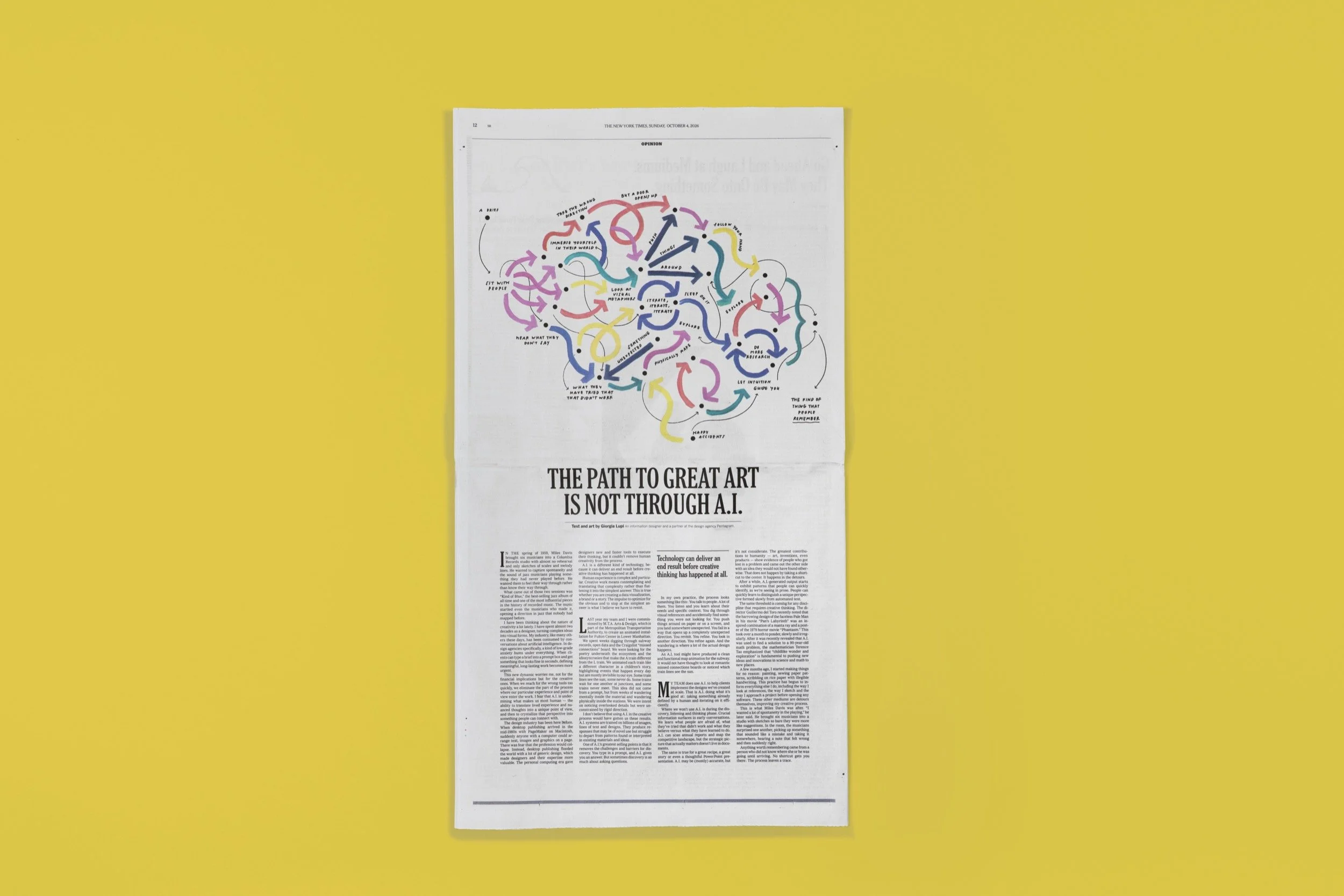
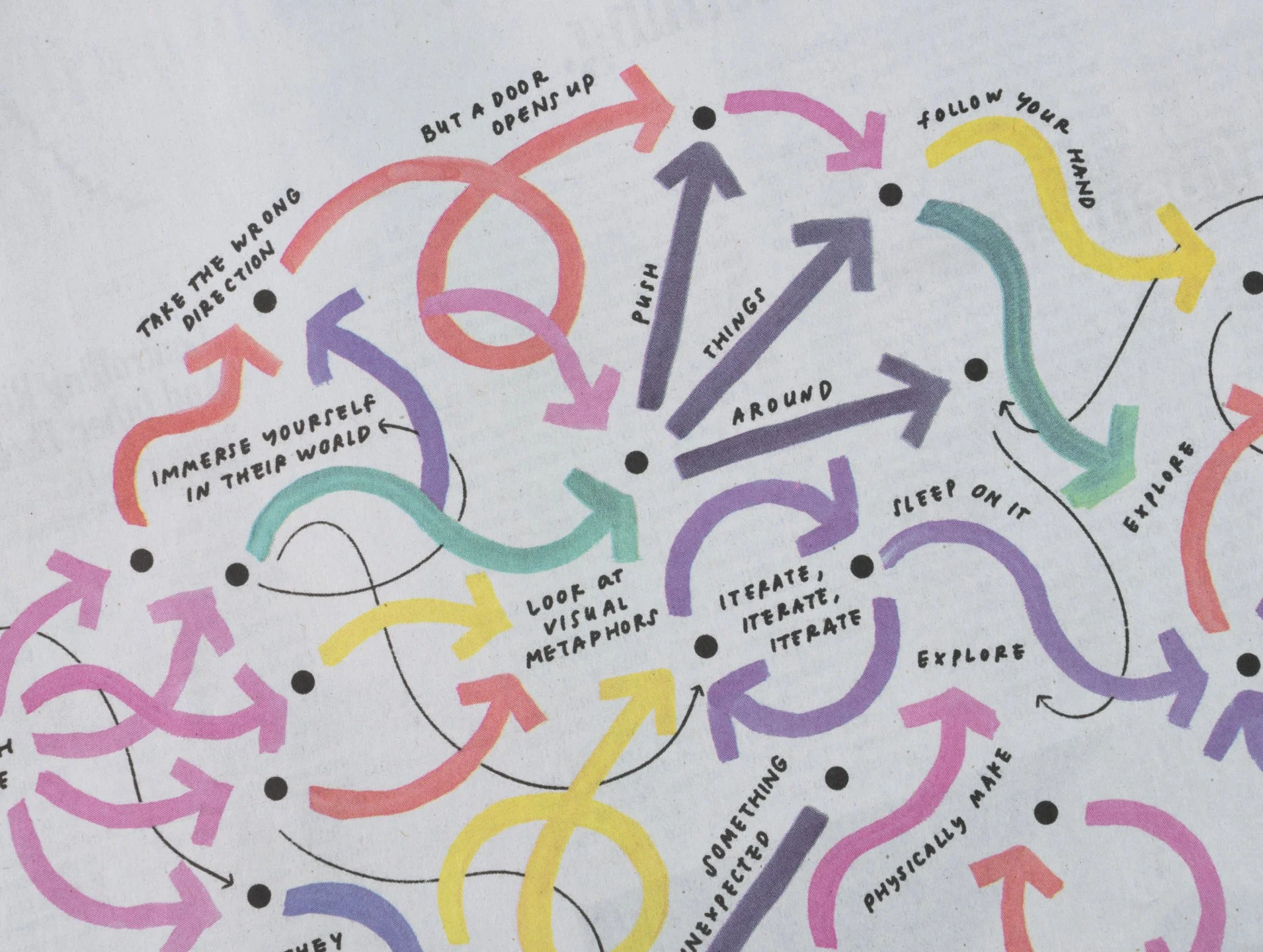
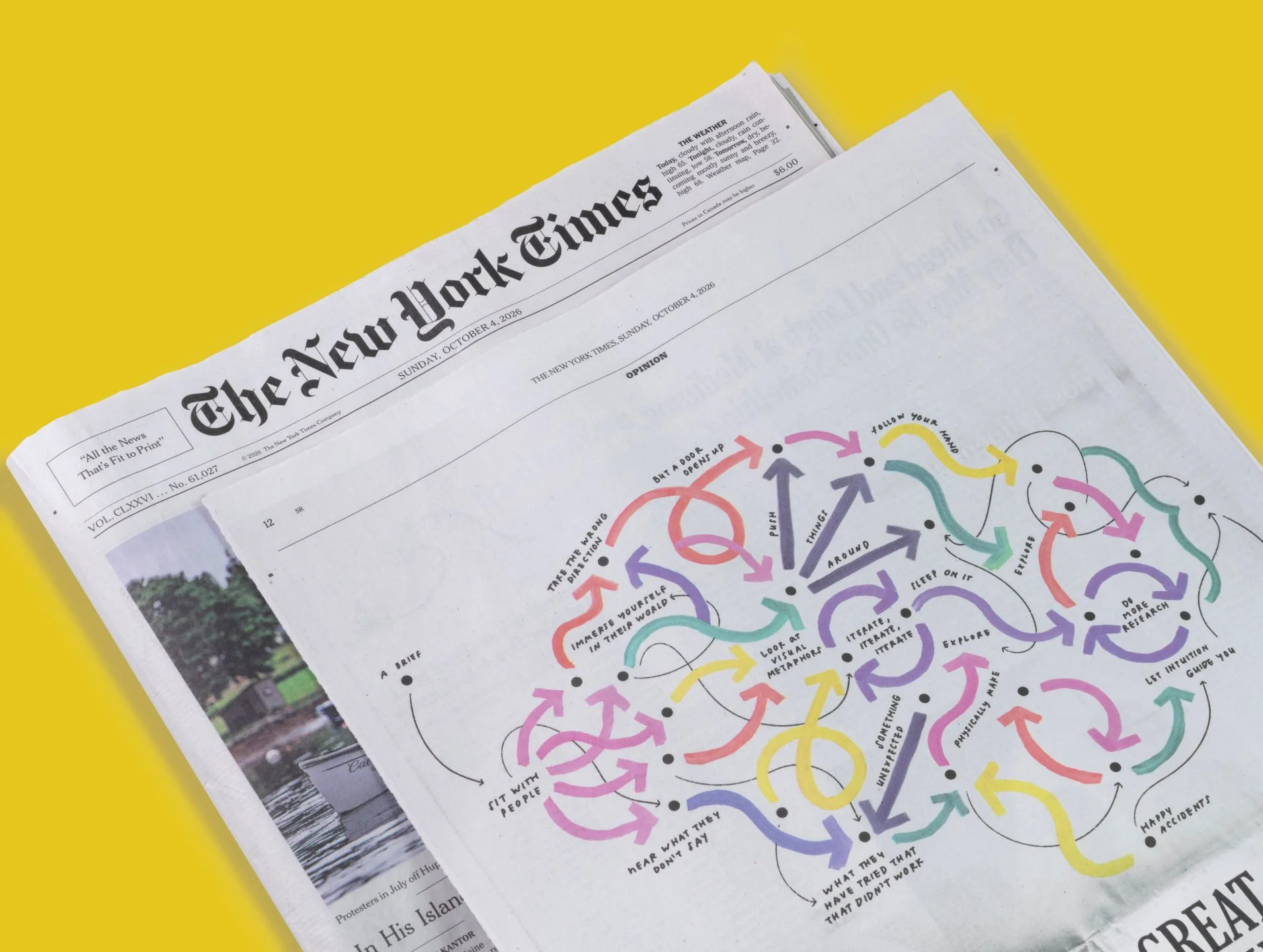
The essay closes with a colorful hand-drawn animation, mapping how projects come together on my team. Unlike in AI’s generative processes, there is only one direct vector—that which goes from the client brief to sitting down with people involved, listening, and immersing yourself. After that, everything in the process is a curved line, looping back on itself, taking myriad directions, and opening doors to see where they lead. Sometimes it means making something with your hands, sometimes it requires starting over again, but the mind always arrives at a unique direction.
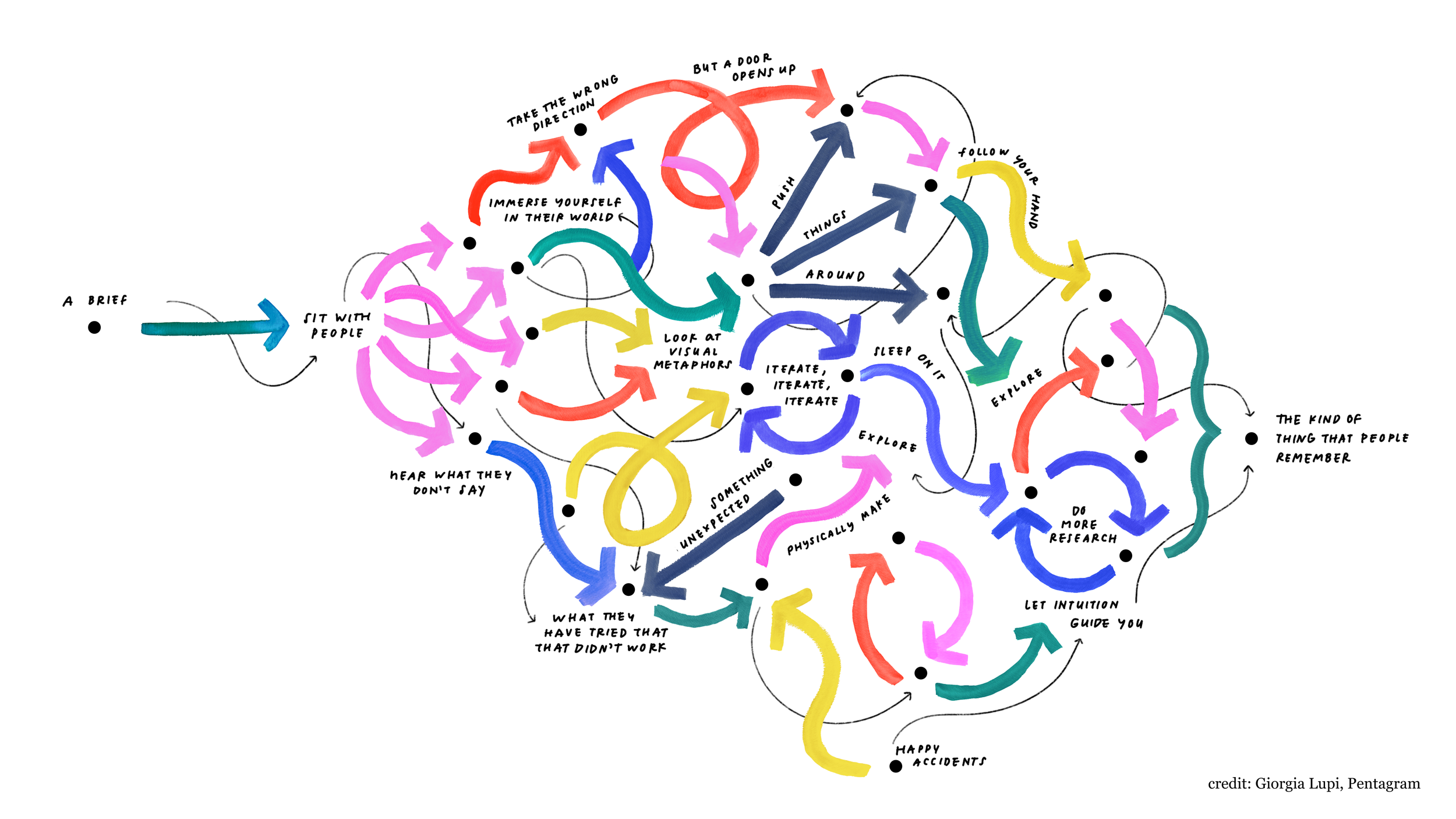
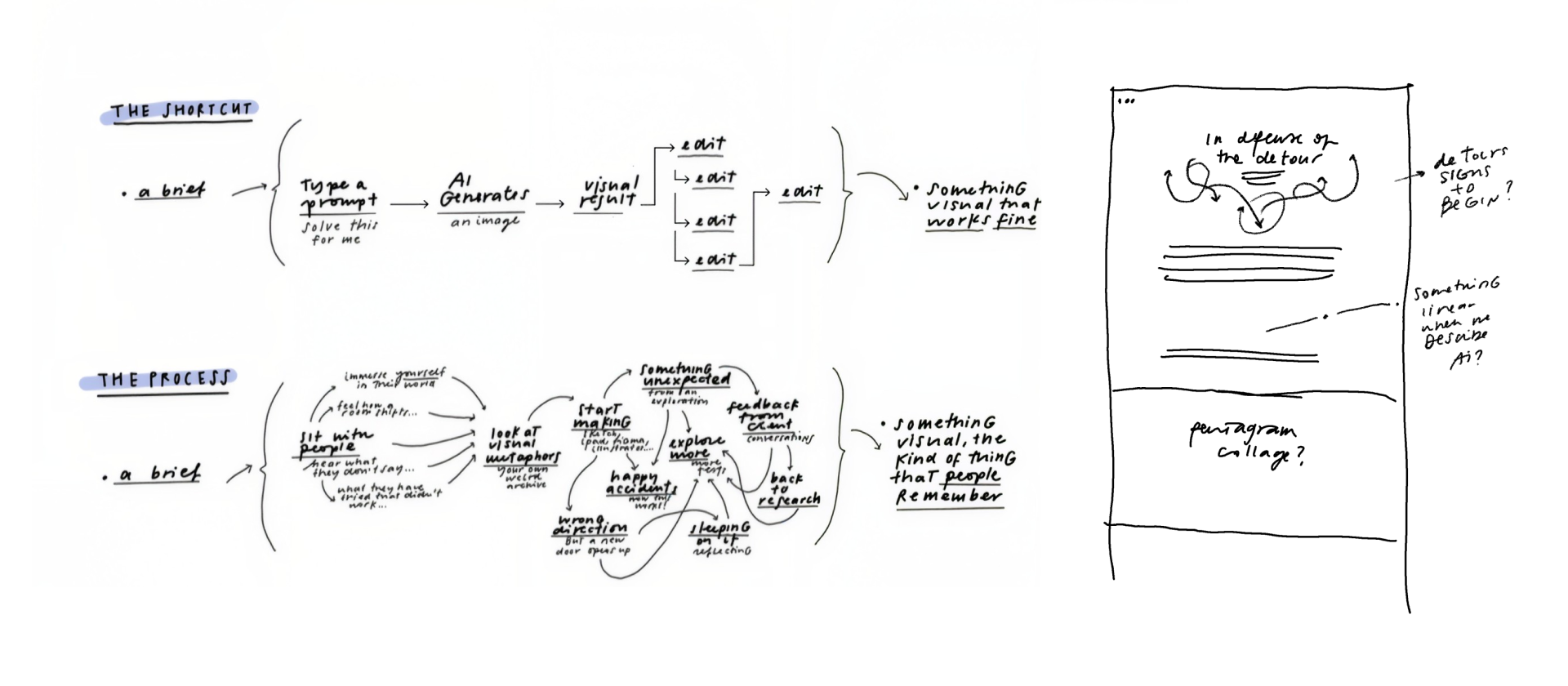
My early sketches that informed the piece
While my team sometimes does employ AI, it is always after that final moment of intuition, when the design is finalized and created, and the client may need to use it to implement and make things at scale. I see promise in this kind of automation, a secondary use that does not infringe on creativity or preclude the chance of a detour.
“Anything worth remembering came from a person who did not know where she or he was going until arriving. No shortcut gets you there: the process leaves a trace.”
To read the full piece, visit The New York Times.
Client: The New York Times · Project team: Rachel Crawford, Julia Saimo, Ryan Yan, Meagan Hughes · Collaborators: Jeremy Ashkenas; Heavy.dev, web development
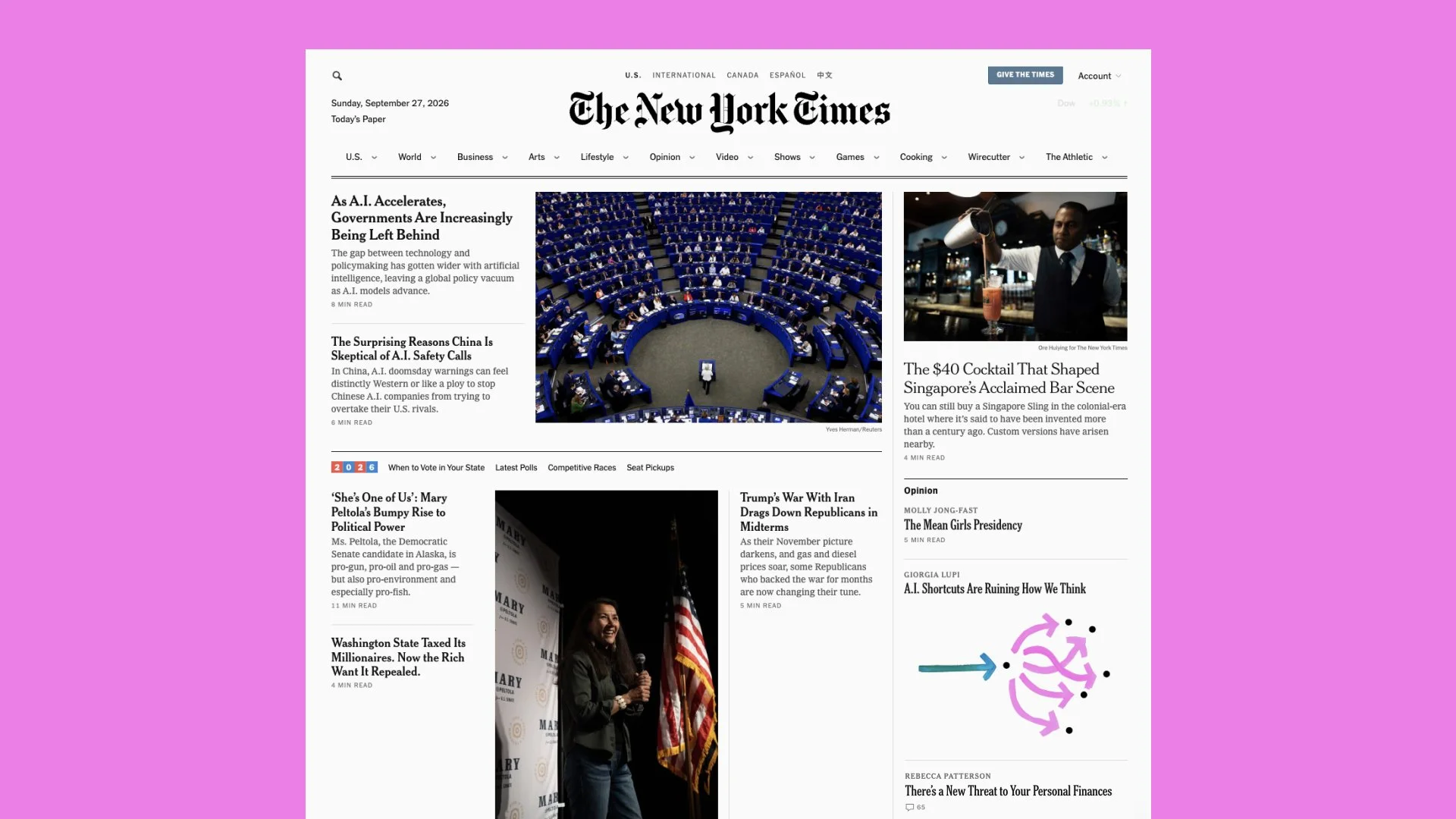
On the New York Times homepage, September 27, 2026